
Helicopter Baggage Allowance and Passenger Capacity for Private Charters in Bodrum +90 552 532 4848
One of the most common questions before booking a private helicopter charter isn’t about the route or the destination — it’s about the practical basics: how many people can actually travel together, and how much luggage can realistically come along. Helicopter baggage allowance and passenger capacity work differently from commercial air travel, and understanding how they’re actually determined helps avoid surprises on the day of your flight.
This guide explains what shapes passenger capacity and baggage limits on a private helicopter charter, why these figures can’t be quoted as a single fixed number across every booking, and what information you’ll typically need to provide so your specific flight can be planned accurately.
Why Helicopter Baggage and Capacity Aren’t Fixed Numbers
Unlike a commercial airline ticket, where baggage allowance is printed on your booking regardless of who else is on the flight, a private helicopter’s capacity for passengers and luggage is calculated together, for each specific flight, as part of what’s known as weight-and-balance planning. The total weight the aircraft can safely carry is fixed by its design, but how that weight is divided between passengers and baggage depends entirely on who and what is travelling on that particular flight.
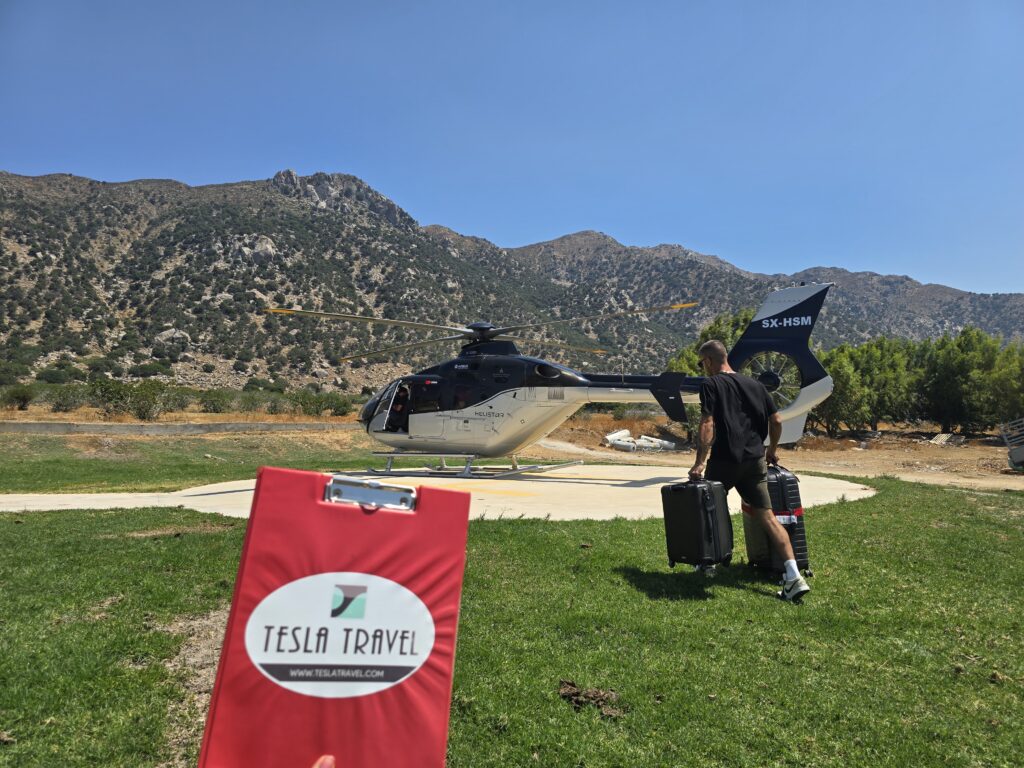
This means the same aircraft could carry four passengers with modest luggage on one flight, and only three passengers with more baggage on another — the aircraft hasn’t changed, but the combination of passenger weights and luggage has. It’s also why a general figure like “carries six passengers” or “allows one bag per person” can be genuinely misleading if presented as fixed, since it depends on the specific people, bags, and aircraft configuration involved in any individual booking.
What Determines Passenger Capacity on a Private Charter
Several factors combine to determine how many passengers can actually travel on a given flight:
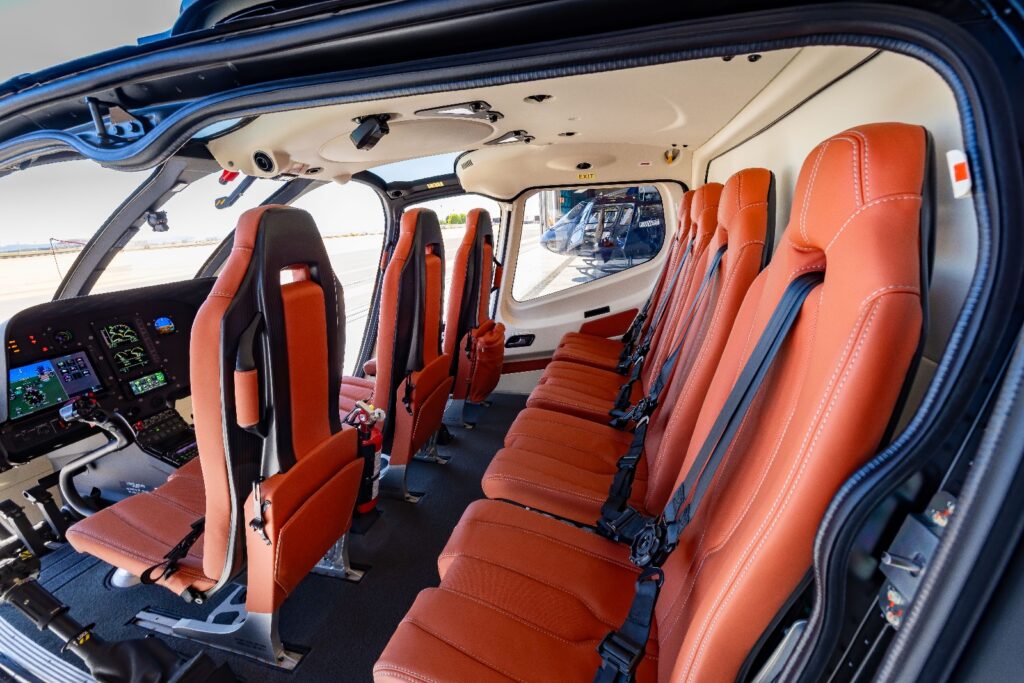
- The aircraft’s cabin configuration, which can vary even within the same aircraft model depending on how it’s fitted out
- Total passenger weight, since this is planned alongside baggage as part of the aircraft’s overall weight limit
- The specific route and flight distance, since longer or higher-altitude routes can affect how much weight margin is available
- Fuel requirements for the route, which factor into the overall weight calculation
- Any additional equipment or crew requirements for that specific flight
Because of this, passenger capacity is confirmed by the operator for each individual booking rather than being a single number that applies to every flight on a given aircraft type. If your group includes more passengers, or if individual passenger weights are higher than average, this can affect how many people can travel together on one aircraft, sometimes requiring two flights instead of one.
What Determines Baggage Allowance on a Private Charter
Baggage works on the same underlying principle. A few points are worth understanding clearly before you pack:
- Baggage capacity varies by aircraft model, and even by the specific configuration of an individual aircraft
- Passenger weight and baggage weight are planned together, not separately, as part of the aircraft’s overall weight-and-balance calculation
- Large, rigid suitcases are often harder to accommodate than soft-sided bags, simply because helicopter baggage compartments are typically smaller and differently shaped than an airline’s cargo hold
- The more passengers travelling together, the less baggage space is generally available per person, since the total weight budget is shared
- Oversized items, sports equipment, or unusually heavy pieces may need to travel separately by road rather than aboard the aircraft
- If the aircraft assigned to your charter changes for any reason, baggage limits can change accordingly
Because exact kilogram limits and piece counts depend on the specific aircraft and passenger load for your flight, these figures are confirmed by your flight coordinator once your passenger and baggage details have been reviewed, rather than published as a single fixed allowance that applies to every booking.
What Is a Private Helicopter Charter?
A private helicopter charter reserves the entire aircraft for your group, rather than selling individual seats on a scheduled route. This is a meaningfully different arrangement from a scheduled flight: your departure time, routing, and the number of passengers travelling are planned specifically around your booking, rather than fixed to a public timetable.
Charters can be arranged as either one-way or return flights, and the scope of the service — whether it runs directly between two private locations or via a heliport or airport on one or both ends — depends on what’s confirmed for your specific route. This is directly connected to passenger capacity and baggage planning, since a longer or more complex itinerary, such as the multi-leg routing available via Kos toward destinations like Mykonos or Santorini, may involve different aircraft or configurations across each leg.
Who Needs to Think Carefully About Capacity and Baggage?
Passenger capacity and baggage planning matter more for some travelers than others:
- Families or groups travelling with children, where car seats or additional equipment may need to be factored in
- Business travelers carrying laptop bags, presentation materials, or equipment cases
- Yacht guests transferring with luggage intended for an extended stay aboard
- Golfers, divers, or travelers with sports equipment that doesn’t fit standard baggage dimensions
- Wedding parties or event guests travelling with formalwear, gifts, or additional items
- Groups planning a full day charter with multiple stops, where luggage needs may differ from a simple point-to-point transfer
Anyone in these situations benefits from sharing detailed passenger and baggage information at the enquiry stage, since this is what allows an accurate capacity and baggage assessment for that specific flight, rather than a general assumption based on aircraft type alone.
Consultation and Flight Planning
To plan passenger capacity and baggage accurately, your flight coordinator will typically need the following details in advance:
- Number of passengers travelling
- Approximate passenger weights
- Number of baggage items
- Baggage dimensions
- Baggage weights
- Any oversized or unusual items, such as sports equipment or musical instruments
- Departure and destination points
- Preferred date and time
- Whether children or infants are travelling, and their ages
Providing accurate figures rather than estimates helps avoid a situation where baggage or an additional passenger can’t be accommodated once you arrive at the departure point, which is far harder to resolve on the day than during the planning stage.
How Capacity and Baggage Fit Into the Booking Process
Passenger and baggage details are reviewed as part of the standard charter booking sequence: after an initial enquiry confirming your route and date, passenger and baggage information is collected and assessed against aircraft availability; a written quotation is then prepared reflecting the aircraft suited to your specific group and luggage; once accepted, this is confirmed as part of your booking. If your group or baggage needs change after this point — for example, an additional passenger joining, or extra luggage being added — it’s important to update your flight coordinator promptly, since this can affect which aircraft is used or whether an additional flight is needed.
Practical Tips for Packing on a Helicopter Charter
- Favour soft-sided bags over large, rigid suitcases where possible
- Declare all baggage, including hand luggage, accurately at the time of booking
- Flag any oversized or unusual items early, so alternative arrangements such as separate road transport can be planned if needed
- Confirm car seat or child equipment requirements well in advance if travelling with young children
- Ask your flight coordinator directly if you’re unsure whether a specific item will be accommodated, rather than assuming
Weather, Safety and Operational Decisions
Passenger capacity and baggage planning are ultimately part of the same safety framework that governs every aspect of a helicopter flight. Weight-and-balance calculations exist because they directly affect how safely an aircraft can operate, alongside factors like weather, visibility, and route conditions. The final decision on what can safely be carried on any given flight rests with the operator and pilot, based on the specific conditions and aircraft involved, rather than being a fixed rule that applies regardless of circumstances.
If a passenger or baggage detail changes unexpectedly close to departure, this can affect the flight plan in the same way weather can — potentially requiring a different aircraft, an adjusted passenger split, or in some cases a rescheduled departure. This is why accurate, early disclosure of passenger and baggage details is treated as seriously as any other part of flight planning.
How Does This Affect Charter Cost?
Passenger count and baggage weight are among the factors that influence overall charter pricing, alongside aircraft type, route distance, and other operational considerations. A larger group or heavier baggage load may require a larger aircraft or an additional flight, which affects the overall cost of the charter. Because pricing depends on the complete picture of your specific trip, a written quotation — requested through Tesla Travel’s live quote service — remains the most reliable way to understand what a particular passenger and baggage combination will cost for your route.
Frequently Asked Questions
How many passengers can a private helicopter carry?
This depends on the specific aircraft assigned to your booking and the combined weight of your group, confirmed by the operator once your passenger details are reviewed rather than fixed for every flight.
How much luggage can I bring on a helicopter charter?
Baggage allowance depends on the aircraft type, passenger count, and overall weight planning for your specific flight. Soft-sided bags are generally easier to accommodate than large rigid cases.
Can I bring sports equipment or oversized items?
This depends on the item’s size and weight relative to available capacity on your flight. Oversized items should be flagged in advance, as they may need to travel separately by road.
What happens if my baggage exceeds the allowance for my flight?
Excess or oversized baggage may need to travel separately by road, arranged in advance with your flight coordinator, since final acceptance depends on the operator’s weight-and-balance assessment.
Does baggage allowance change if my group size changes?
Yes, since passenger and baggage weight are planned together. Adding passengers can reduce the baggage capacity available per person, and should be communicated as soon as possible.
Can children travel on a private helicopter charter?
This depends on the child’s age, applicable seating and restraint requirements, and the aircraft’s configuration, all of which need to be confirmed with your flight coordinator in advance.
Is passenger capacity the same across all helicopter charters?
No, capacity depends on the specific aircraft and configuration used for your booking, along with passenger weights and baggage, so it varies from one charter to another even on similar routes.
Do I need to declare baggage weight before booking?
Yes, providing accurate baggage dimensions and weight in advance allows your flight coordinator to plan your flight correctly and avoid issues at the departure point.
Can baggage be split across multiple flights if my group is large?
In some cases, yes, particularly for larger groups requiring more than one aircraft. This is assessed and arranged as part of your specific booking.
Who makes the final decision on what can be carried on a flight?
The operator, based on weight-and-balance requirements for the specific aircraft, passengers, and conditions on the day, makes the final determination — not a fixed general policy that applies regardless of circumstances.
Planning Ahead for a Smooth Departure
Understanding how passenger capacity and baggage allowance actually work — as a calculation specific to your aircraft, group, and route, rather than a fixed number — is one of the most practical steps toward a smooth charter experience. Sharing accurate passenger and baggage details early gives your flight coordinator the best chance of confirming the right aircraft for your trip well before departure day. For a specific route, group size, or baggage requirement, requesting a written quote directly is the most reliable way to understand exactly what’s achievable for your booking.