
Rhodes to Mykonos Helicopter: Two Icons of the Aegean, Connected in Style. The Aegean holds no shortage of extraordinary islands, but two stand apart in the imagination of travellers who have explored this sea seriously. Rhodes — ancient, monumental, and layered with millennia of history — anchors the south-eastern corner of the Greek island world. Mykonos — cosmopolitan, luminous, and endlessly energetic — reigns over the central Cyclades.
Between them lies open water, scattered islands, and one of the most rewarding helicopter routes in the entire Mediterranean. Tesla Travel’s Rhodes to Mykonos helicopter service connects these two icons in approximately 60 minutes, with nothing between you and the Aegean but altitude and clear sky.
Travelling between Rhodes and Mykonos by conventional means has always required patience that most luxury travellers simply do not have. Connecting flights via Athens consume the better part of a day. Ferry connections are slow, indirect, and dependent on schedules that rarely align with anyone’s preferred itinerary. The Rhodes to Mykonos helicopter transfer eliminates every one of those frustrations and replaces them with an arrival experience that sets the tone for everything that follows.
Rhodes to Mykonos Helicopter
Tesla Travel operates the Rhodes to Mykonos helicopter route as a fully private, end-to-end transfer service departing from Rhodes Airport or a designated helipad location on the island. The flight tracks north-west across the Aegean, passing over the Dodecanese before entering Cyclades airspace and approaching Mykonos from the south-east.
Total flight time is approximately 55 to 65 minutes depending on conditions and routing, making the Rhodes to Mykonos helicopter one of the most efficient inter-island connections available anywhere in the Greek islands.
Every transfer is operated by certified pilots aboard a well-maintained private helicopter fleet. All permits, airspace coordination, and ground arrangements at both Rhodes and Mykonos are managed by the Tesla Travel operations team. The passenger experience is seamless from collection to touchdown — no queues, no shared terminals, no compromises.
Why Choose a Private Helicopter from Rhodes to Mykonos?
Rhodes and Mykonos sit approximately 300 kilometres apart as the crow flies. By commercial flight, the only realistic option is a connecting service via Athens — which means two flights, an Athens layover of at least two hours, and a total door-to-door journey time that rarely falls below six or seven hours even on a good day. By ferry the situation is substantially worse, with no direct high-speed connection and journey times that stretch to twelve hours or more via intermediate stops.
The Rhodes to Mykonos helicopter covers the same distance in under an hour. Departure is on your schedule. The aircraft is yours exclusively — no other passengers, no announcements, no delays caused by factors outside your control. The route passes over some of the most beautiful open water in Greece, and the aerial perspective of the Dodecanese and Cyclades islands from altitude is a visual experience that genuinely cannot be replicated by any other form of transport.
For travellers who are combining a historical itinerary on Rhodes with the glamour of Mykonos, the helicopter transition also serves a practical psychological function — it marks a clear and dramatic shift between two very different island experiences, signalling the change with the kind of arrival that stays in the memory long after the trip has ended.
About Rhodes: Where the Journey Begins
Rhodes is one of the most historically significant islands in the entire Mediterranean, and one of the most underestimated by travellers who have not yet visited it. The island sits at the southernmost tip of the Dodecanese, closer to the Turkish coast than to Athens, and its position at the crossroads of ancient sea routes gave it an importance that has left extraordinary traces across its landscape.
The Medieval Old Town of Rhodes
The old town of Rhodes is the defining reason to visit the island and one of the most remarkable urban environments in Greece. Enclosed within massive Crusader walls built by the Knights of St. John in the 14th and 15th centuries, it is a UNESCO World Heritage Site that functions simultaneously as a living town and an open-air museum of medieval architecture on a scale that few places in Europe can match.
The Street of the Knights — the most complete medieval street surviving anywhere in the world — runs from the harbour gate to the Palace of the Grand Master, a fortress of extraordinary scale that was restored in the early 20th century and now houses important archaeological collections.
The old town’s bazaar quarter, the Turkish quarter with its Ottoman mosques and fountains, and the Jewish quarter with its medieval synagogue layer different historical periods into a single compact space that rewards days of exploration.
Lindos and the Acropolis
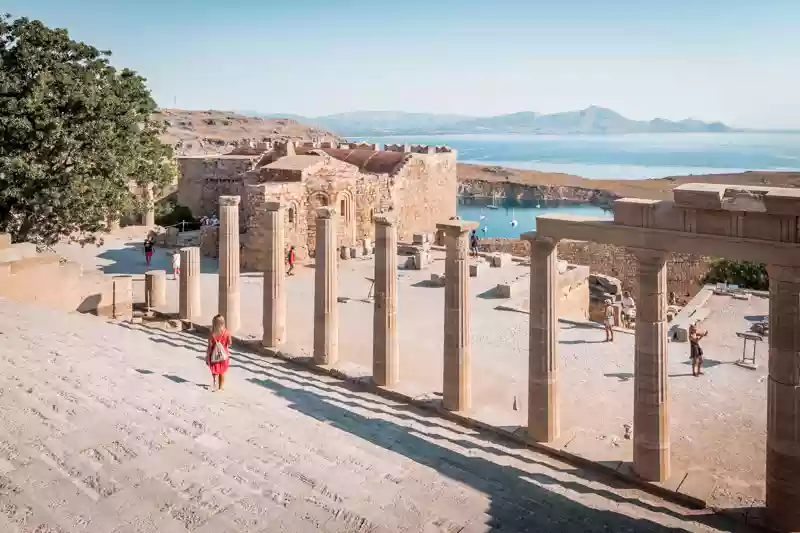
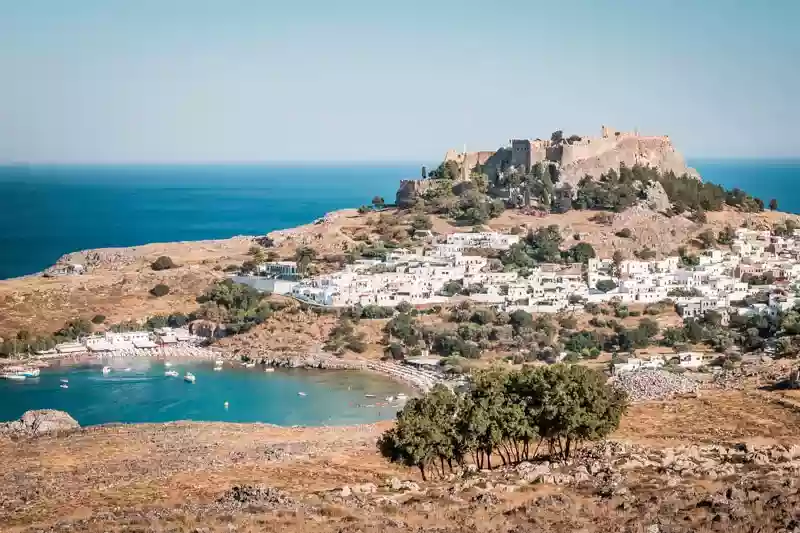
Beyond the old town, the most compelling destination on Rhodes is Lindos — a village of dazzling whitewashed houses perched on a rocky headland on the island’s eastern coast, crowned by a Doric acropolis that rivals anything in Athens for the drama of its setting. The view from the acropolis columns across Lindos Bay — a perfect crescent of turquoise water enclosed by golden cliffs — is one of the great panoramas of the Aegean.
The village below is a maze of captains’ houses decorated with distinctive black and white pebble mosaics, and its small harbour and main beach are among the most attractive on the island.
The Beaches of Rhodes
Rhodes has an exceptional coastline that stretches for over 220 kilometres, encompassing beaches of every character. Faliraki on the eastern coast is the island’s largest and most developed resort beach, offering the full spectrum of water sports and beach club facilities. Tsambika Beach, further south, is a wide arc of fine golden sand consistently rated among the best beaches in the Dodecanese.
Anthony Quinn Bay — named after the actor who fell in love with it during the filming of The Guns of Navarone — is a rocky cove of extraordinary colour and clarity. On the western coast, Prassonisi at the island’s southern tip is a famous windsurfing destination, where the Aegean and Mediterranean seas meet in conditions that attract experts from across Europe.
Rhodes as a Gastronomic Destination
Rhodian cuisine reflects the island’s complex history — Greek, Ottoman, Italian, and Jewish culinary traditions have all left their mark. The old town’s restaurants range from traditional tavernas serving slow-cooked local dishes to contemporary fine dining venues with caldera and harbour views.
The island produces its own wine from indigenous grape varieties, and its olive oil, honey, and fresh seafood are of exceptional quality. A meal at one of the old town’s better restaurants, eaten in a medieval courtyard under the stars, is one of the genuinely distinctive dining experiences available anywhere in the Greek islands.
About Mykonos: Where the Journey Ends
Mykonos requires little introduction — its reputation precedes it across every continent. But arriving on the island by private helicopter rather than by ferry ramp or crowded airport terminal changes the nature of that arrival entirely. You come in from above, with the full geography of the island visible beneath you: the whitewashed mass of Chora, the windmills on their ridge, the beach clubs of the southern coast already busy with the afternoon crowd, the superyachts at anchor in the bay. It is, without question, the finest way to begin a Mykonos stay.
Mykonos Town and Little Venice
Mykonos Town, known universally as Chora, is a dense and deliberately disorienting labyrinth of narrow whitewashed lanes whose layout was designed to confuse both the fierce Aegean winds and, historically, pirates raiding from the sea. Within this labyrinth lies Little Venice — a row of 18th-century sea captains’ houses whose coloured wooden balconies extend directly over the water, creating one of the most romantically charged and photographed streetscapes in the Mediterranean.
Above the town, the Kato Mili windmills — a row of white cylindrical towers with their original wooden sails — frame every sunset over the harbour in the silhouette that has become the defining image of the Cyclades.
The Beach Clubs of Mykonos
Mykonos has built its modern reputation on the quality of its beach club culture, and that reputation is completely deserved. The island’s south-facing coast is sheltered from the meltemi wind that blows through the Cyclades in summer and receives the full force of the Aegean sun, making it ideal for extended beach days. Psarou Beach, backed by Nobu Mykonos, is the most exclusive stretch on the island and the preferred destination for arrivals by superyacht tender or private helicopter.
Paradise Beach and Super Paradise are legendary for their DJ sets and party atmosphere, drawing an international crowd that keeps the energy high from midday well into the evening. Ornos and Agios Ioannis offer a quieter alternative — long sandy bays with clear water and a more relaxed pace.
Mykonos Nightlife and Dining
After dark, Mykonos shifts into a different register entirely. The town’s bars and clubs — many of them world-famous venues that attract international DJ talent throughout the season — keep the island animated until well after dawn. The restaurant scene is equally serious, with a range that extends from traditional waterfront tavernas serving fresh fish caught that morning to acclaimed fine dining venues with Cycladic-inspired menus and views across the caldera. For travellers arriving from the historical intensity of Rhodes, Mykonos offers a complete and welcome contrast.
Delos: The Sacred Neighbour
No engagement with Mykonos is fully complete without at least an awareness of Delos, the tiny uninhabited island visible from the Mykonos waterfront and reachable by a short boat crossing. Delos is one of the most important archaeological sites in Greece — the mythological birthplace of Apollo and Artemis and for centuries one of the most sacred and commercially significant locations in the ancient Mediterranean world. Its ruins, including temples, a theatre, elaborate floor mosaics, and the famous Terrace of the Lions, are extraordinarily well preserved. Because Delos receives no overnight visitors, access is only possible by day trip from Mykonos. Tesla Travel can coordinate private boat arrangements for guests wishing to include it in their programme.
The Rhodes to Mykonos Helicopter Route in Detail
Flight Time and Distance
The direct distance from Rhodes to Mykonos is approximately 290 to 310 kilometres depending on the specific routing. By private helicopter at cruising speed, the crossing takes between 55 and 65 minutes — making the Rhodes to Mykonos helicopter one of the most time-efficient connections available between the Dodecanese and the Cyclades.
Departure Points on Rhodes
Tesla Travel can coordinate Rhodes to Mykonos helicopter departures from Rhodes International Airport Diagoras, from designated helipad locations near Rhodes Town, or from private properties on the island with suitable landing areas. When making your enquiry, indicate your accommodation or preferred departure point and the operations team will confirm available options and logistics.
Combining Rhodes with a Wider Aegean Itinerary
The Rhodes to Mykonos helicopter transfer fits naturally into a broader island-hopping programme. Travellers can arrive in Rhodes from Bodrum by sea or air and continue to Mykonos by helicopter on the same day. From Mykonos, Tesla Travel’s custom Greek islands routes service offers onward connections to Santorini, Paros, Ios, and other Cyclades destinations. Rhodes can equally serve as the conclusion of a circuit that begins in Mykonos and works south through the islands.
Book Your Rhodes to Mykonos Helicopter with Tesla Travel
How long does the Rhodes to Mykonos helicopter flight take?
The flight from Rhodes to Mykonos takes approximately 55 to 65 minutes at cruising speed. Total transfer time from your departure point to your Mykonos destination is typically between 90 minutes and two hours, depending on ground logistics at each end.
Where does the helicopter depart from on Rhodes?
The primary departure point is Rhodes International Airport Diagoras. Transfers from Rhodes Town or other island locations can be arranged upon request.
Do I need a passport to fly from Rhodes to Mykonos?
Both Rhodes and Mykonos are Greek islands, so travel between them is a domestic flight within Greece. A valid Greek national ID or passport is accepted for EU citizens. Non-EU passengers should carry their passport as standard travel documentation.
How much does the Rhodes to Mykonos helicopter cost?
Pricing depends on travel date, group size, and any additional services requested. Private helicopter charters are priced per flight rather than per seat, making the per-person cost considerably more competitive for groups of three or more. Contact Tesla Travel via WhatsApp or at helicopter.teslatravel.com for a same-day personalised quote.
Can I book a return helicopter from Mykonos to Rhodes?
Yes. Tesla Travel operates the route in both directions and can arrange return transfers or multi-leg itineraries combining Rhodes, Mykonos, and other Aegean destinations in a single seamless programme.
The Aegean is best seen from above. Contact Tesla Travel today at helicopter.teslatravel.com to book your Rhodes to Mykonos helicopter transfer and move between two of Greece’s greatest islands in the way they deserve.